For weeks I brushed off all the imploring invitations to step into my shop, welcome, just see, look lady, you don't have to buy, just see lady, welcome, welcome, please, have some coffee, maybe mint tea?
The merchants in the Old City are desperate for customers but even in the good years, good years which have not yet returned, they intimidated me with the endless hassling. It made me crazy. It was the Jerusalem version of squeegee kids.
I was wrong. I should have accepted the invitations.
The hard sell is there, sure it is, but many of the shops are good and the people who own them interesting, charming and easy-going. I have made many good friends among the merchants of the Old City and will miss them when I go home.
But with so many shops, strung along the great streets of the Old City - Christian Quarter Street, David Street, El-Khanqa, Armenian Patriarch Road, Derech Sha'har Ha'arayot - how can you figure out the ones to enter?
Forget trying to decide on the basis of what you need or what you know. Go with what you feel when these merchants show off their best goods. They like to talk and get to know you; when they are a little surer of who you are and what you may be open to, they'll push past the trays of film, the postcards and the Hebron pottery (which I happen to like, okay?) and pull out the pieces which can make your pulse quicken.
Heard of suzanis? I hadn't - not until about three weeks ago. I stumbled over them with a friend when we edged in to one dusty place to look at Palestinian embroideries and old rugs.
"What are these?" I stuttered. "These!" The shopkeeper instantly dropped the stuff he'd pulled out for me and started unfolding suzanis - wonderful, gorgeous, breathtaking. My friend knew all about them; in fact she has a few. Hers, like these ones in the pictures, are antiques.
Suzanis are richly embroidered fabrics made as decorations, bedspreads, curtains, even pillow cases. And they were made in the 'Stans - Uzbekistan, Turkestan, Afghanistan...
The best ones you see now are at least 150 years old, but most of the ones in the shops are about 50 years old. The poppy is the most persistent symbol in them and the pieces come in various colours although most are stitched in reds or pinks with blue, tan, yellow and green silk threads.
I am also hooked (and have been for years) on handpainted Armenian pottery - the tiles, the dishes, the sinks, the lamps and bowls - all covered with the peacocks and flowers and trees and traditional motifs of this culture. There is a ton of nice Hebron pottery around that imitates it, but the real pieces levitate compared to the copies. At home in Toronto, we have a Tree of Life tile mural we had shipped from Balian's on the Nablus Road; for years it waited in a cupboard, each piece wrapped like a little present, until we could afford to renovate our kitchen. Now it fills the space over the stove. Our big buy on this trip is a handpainted sink from the Sandrouni pottery in the Armenian Quarter of the Old City; it will go to the cottage and rest there until we can afford a new bathroom.
Then there are the beads and the bead shops. The pal who taught me about suzanis also showed me the best old beads to buy and I am hooked. It's like crack. My hunt for them has taken me all over Jerusalem and now I am making necklaces for my daughter's wedding. Not with old beads, though; we're going for a more bridal look. Pearls and such. More expensive too, I might add.
On the Farm

Thursday, May 26, 2005


I do not understand my new passion for camels

Camels, camels, everywhere! I am besotted and bewildered by these amazing animals.

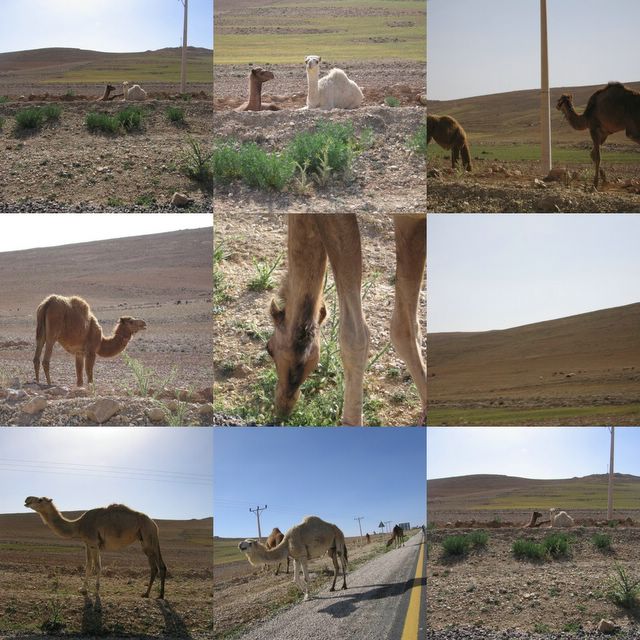

Say cheese!

Camels at Petra - characters, all and how vain. Not that you could blame them; look at those wonderful saddlebags. I like the one with the great teeth and the one sleeping with her head in the sand.
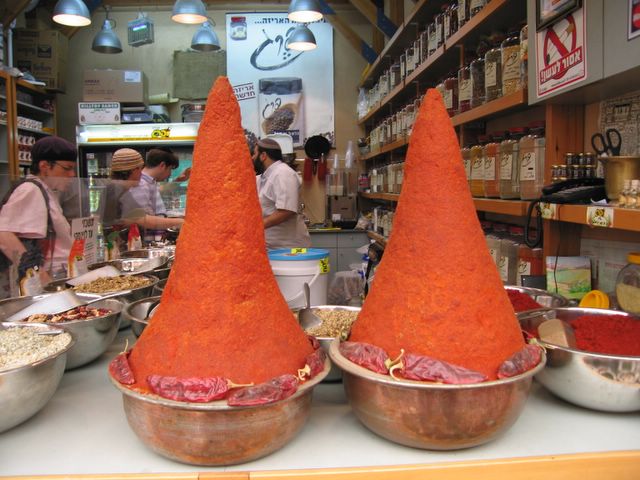
Lunch: In Jerusalem, at the Mahane Yehuda Market, it always starts with pita
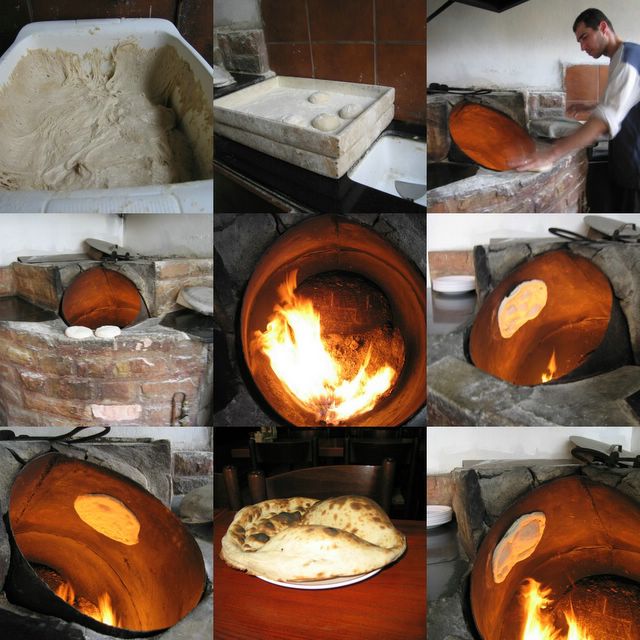
Steps to fresh pita: making the dough, patting it into a round, stretching it over a round disk of cloth, slapping it against the wall of a ferocious oven powered by gas, letting it bubble and brown
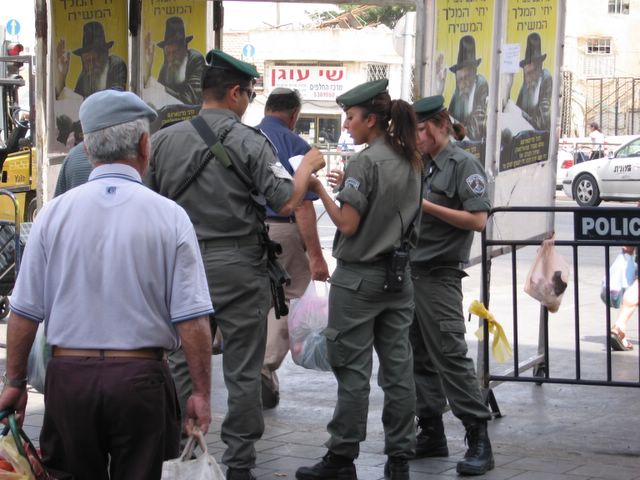
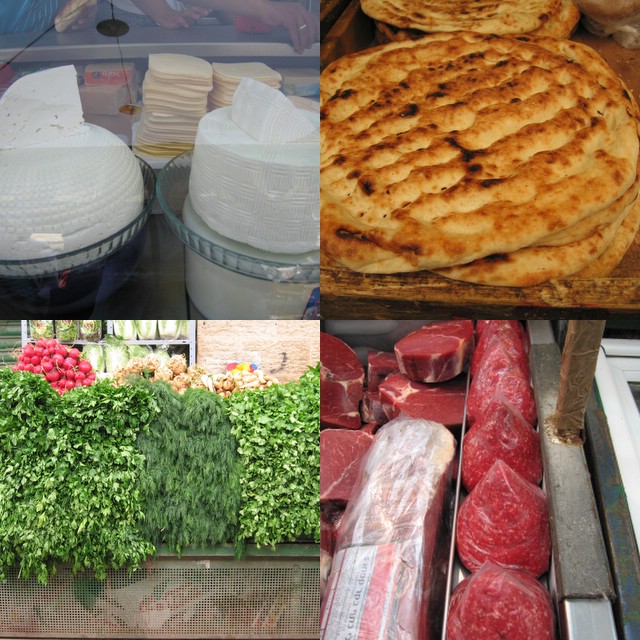

Returning to Galilee
In 1996 David and I visited Galilee with Marg and Cameron Brett, our dear friends in Toronto; Cameron is the minister at our church, St. Andrew's, and it was great for us to be with someone who had some knowledge of the history in this beautiful part of Israel.
Not that he wanted to teach us anything; I think Cameron was happy to be as much a tourist as the rest of us - but, when pushed, he explained the significance of each site in a way we have never forgotten.
Not that he wanted to teach us anything; I think Cameron was happy to be as much a tourist as the rest of us - but, when pushed, he explained the significance of each site in a way we have never forgotten.
Has anything changed in the last eight years? Fortunately, yes. Whoever controls these Christian sites has finally thought out the parking, rest spots, shops and information - they are discreet, modern and beautiful and each is completely appropriate to its location.
We've driven up there from Jerusalem many times since we arrived in February. Most of the time we drive north along the Israel-Jordan border past Joshua's town of Jericho, which is controlled by the Palestinian Authority, and then up into the Golan Heights which overlook Jordan, Lebanon and Syria as well as the Sea of Galilee itself - called Lake Kinneret by most Israelis. Today the Golan is a lush farming area, filled to the horizons with fields of onions, potatoes and wheat, interrupted here and there by machine gun nests, heavily fortified military camps and snarls of barbed wire protecting communications towers.
The route we like best takes us about half-way across the top of the Golan and then hairpins down to the water and along the shores of Galilee to the sites most revered by Christians.
Why do we like these places so much? Because of their modesty, simplicity and authenticity. There is none of the appalling kitsch of the Church of the Holy Sepulchre in Jerusalem's Old City or the dubious claims, proclaimed by General Gordon, of the charming Garden Tomb by the East Jerusalem Bus Station.
We've driven up there from Jerusalem many times since we arrived in February. Most of the time we drive north along the Israel-Jordan border past Joshua's town of Jericho, which is controlled by the Palestinian Authority, and then up into the Golan Heights which overlook Jordan, Lebanon and Syria as well as the Sea of Galilee itself - called Lake Kinneret by most Israelis. Today the Golan is a lush farming area, filled to the horizons with fields of onions, potatoes and wheat, interrupted here and there by machine gun nests, heavily fortified military camps and snarls of barbed wire protecting communications towers.
The route we like best takes us about half-way across the top of the Golan and then hairpins down to the water and along the shores of Galilee to the sites most revered by Christians.
Why do we like these places so much? Because of their modesty, simplicity and authenticity. There is none of the appalling kitsch of the Church of the Holy Sepulchre in Jerusalem's Old City or the dubious claims, proclaimed by General Gordon, of the charming Garden Tomb by the East Jerusalem Bus Station.
Where Jesus lived and taught
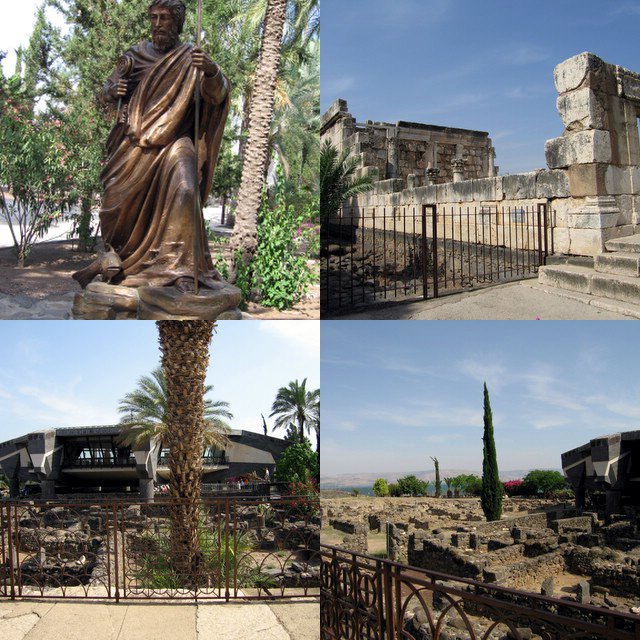
At St. Peter's house in Capernaum: a statue of St. Peter; the synagogue where Jesus taught; the new - and shamefully ugly - church built over the foundation of Peter's house where Jesus lived; some remains of the other houses around Capernaum
At The Mount of the Beatitudes

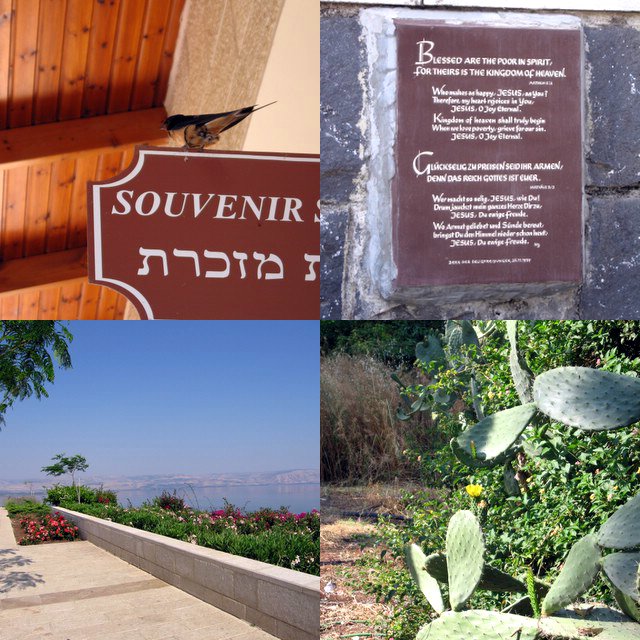
The monastery at the Church of the Beatitudes; the visitors' centre is at the far centre; the garden in bloom; a walkway to the lake...

Now you may understand why I think this is the most beautiful of all the Christian sites in Israel. The eight-sided Church of the Beatitudes; a porch looking west towards Tiberias; the view looking down the Mount of the Beatutudes to the Sea of Galilee (white netting covers grapevines) and the porch looking towards the east and the Golan Heights.
At St. Peter's Church in Galilee
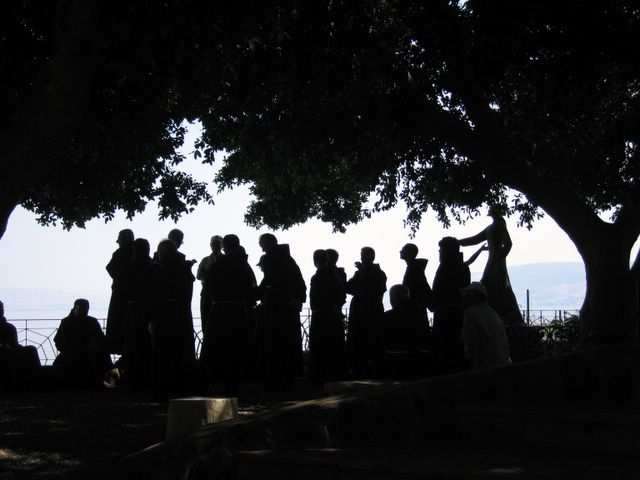
Visiting monks hold an impromptu service by St. Peter's Church at Capernaum - beside the statue of Jesus appearing to Peter after the resurrection (right)
St. Peter's Church at Capernaum
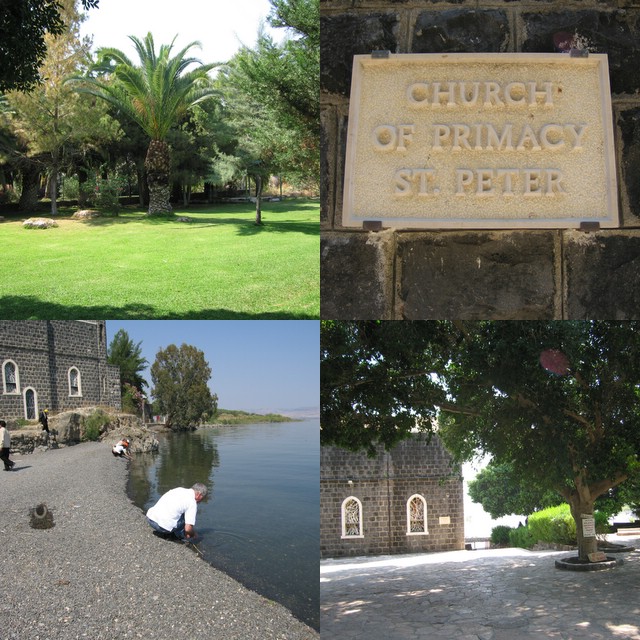
Coming down the walk to the Church of the Primacy of Peter, built by Franciscans in 1938 on the foundations of a Byzantine church. This is where Jesus is said to have appeared to his disciples after the Resurrection and given the leadership to Peter. Visitors, as David is doing here, often take pebbles from the lakeshore to give to sick and grieving friends and relatives.
From the Greek monastery to St. Peter's house
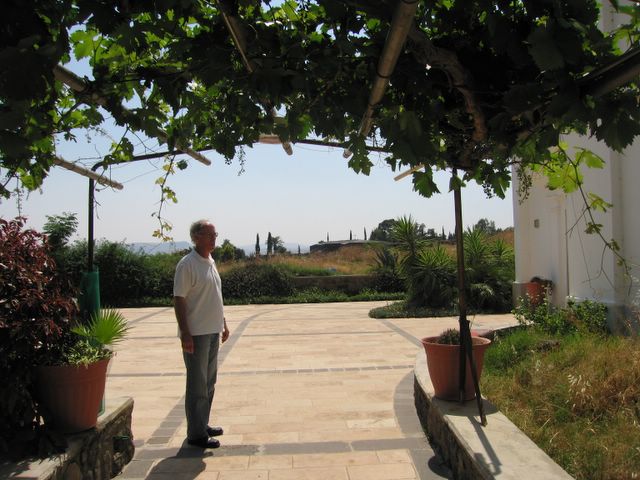
David at the bubble gum Greek monastery; behind him is the roof of Peter's house by the shore where Jesus lived and taught
The Greek Monastery at Capernaum
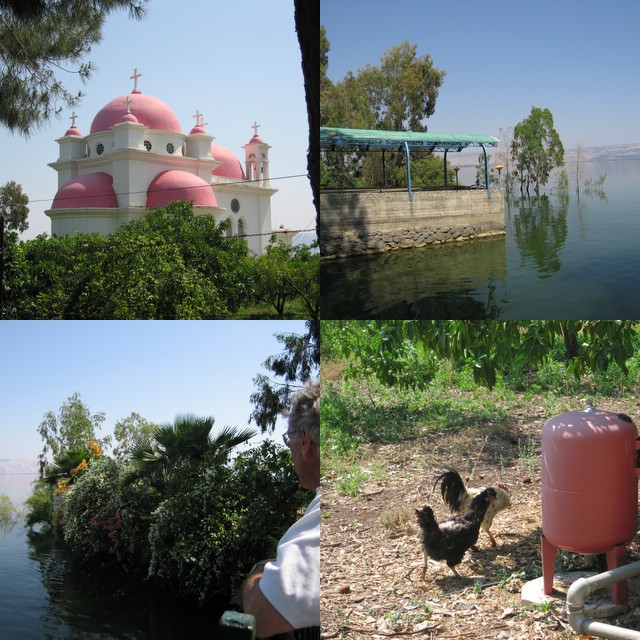
The bubble gum monastery is surrounded by beautiful gardens; the landing place; David at the shore; chickens in the vegetable garden
Wildlife at Capernaum
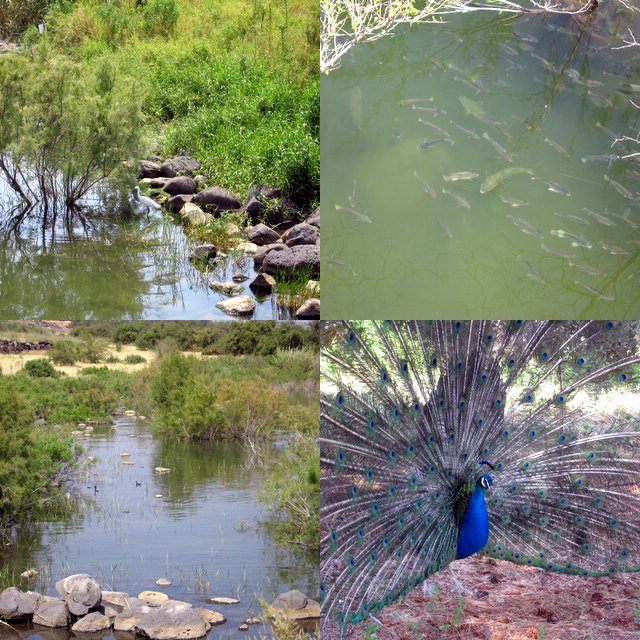
An egret goes fishing by the shore; schools of fish by the dock; cormorants taking their ease; a peacock trying to woo his indifferent mate
Arriving at Capernaum on the Sea of Galilee
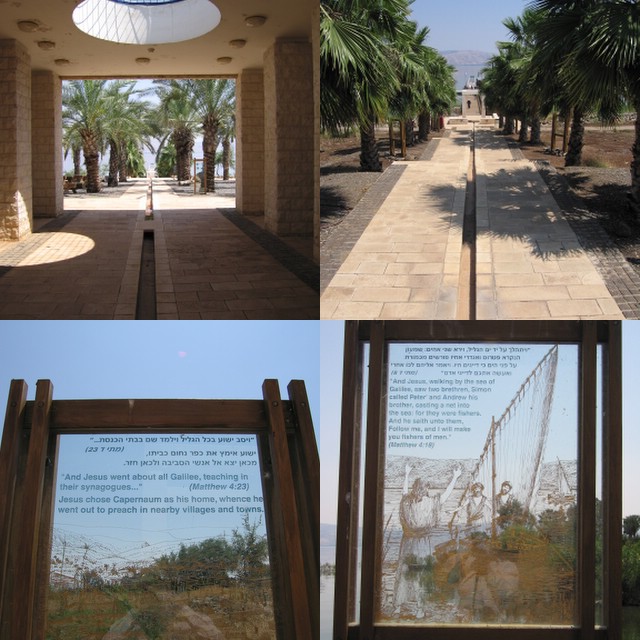
Entering the visitors' centre at Capernaum; looking back up the hill from the water; two of the etched glass guides to the history of this site
The Golan Heights - on our way to Galilee
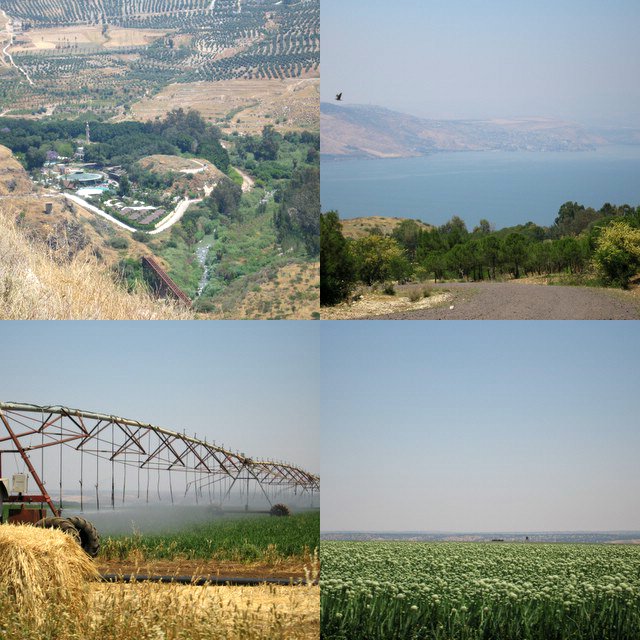
Looking down from the Golan Heights to the Jordan River and across into Jordan; coming down the road to the Sea of Galilee with an eagle headed our way; a massive sprayer waters crops on the Golan; a field of onions in bloom
Wednesday, May 11, 2005
Visiting Bethlehem - a sad and desperate town
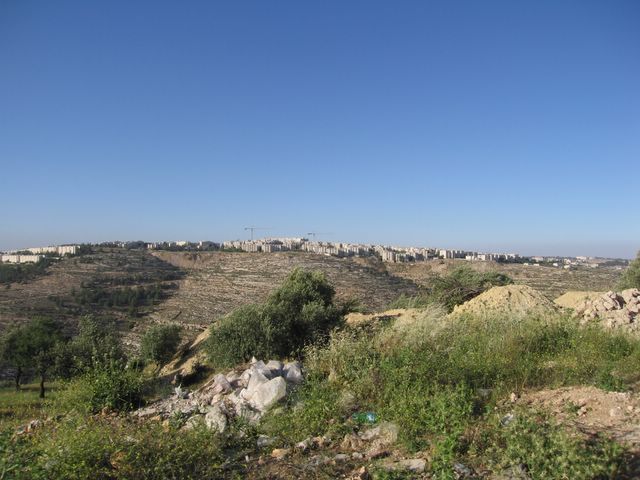
Settlements roll over the hills in the West Bank near Bethlehem.
When we were last here in 1996, Bethlehem - just a 15-minute drive from central Jerusalem - was a bustling, prosperous town. We could drive there without being hassled at checkpoints. Not now. Now we have to sneak in through someone's driveway.
Eight years ago the shops around Manger Square were full of tourists (despite the fact that water was regularly cut off to the town's merchants). Today most of the shops are closed for good; few restaurants are doing well.
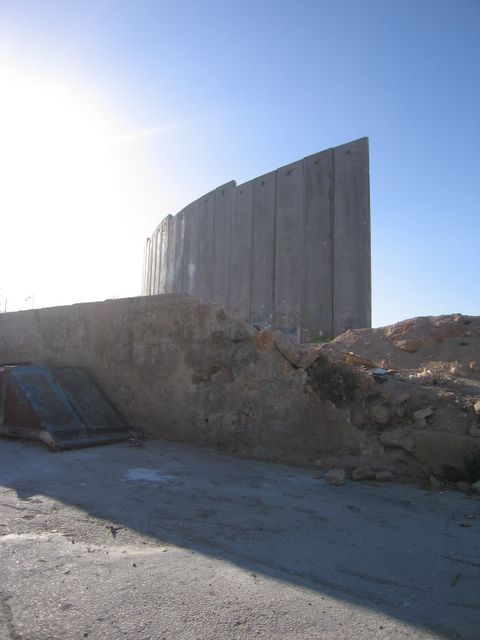
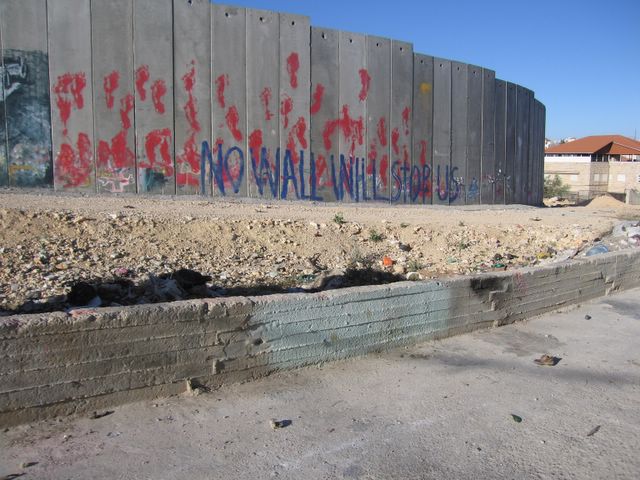
Getting to work in Jerusalem can take several hours a day for Palestinian Christians and Arabs. And now the Wall is encroaching on the town's outskirts, slicing throught the communities.

Independence Day in Israel: Fireworks
Today the Israelis are celebrating their 57th Independence Day and flags are flying from apartment balconies, from cars and taxis and from flagpoles all over the city. A few days ago, just to make sure we knew what was expected of us, our morning paper came with large free flag tucked inside.
It has been a joyful day for Israelis and tonight in my quiet apartment I hear music and cheering and honking horns float across the neighbourhood. Just a few minutes ago popping and whistling noises began outside; when I went out on the terrace to investigate I saw that a block away fireworks had started.
Last night was quite different. It was a day of remembrance, to mourn the dead of the Intifada and other wars. A horn blew for a long time and the whole city stopped.
Late last night I took David to the airport in Tel Aviv to catch a plane home to Canada for some meetings. As we drove down the mountain highway to the flat plains of the coast, we passed the shells of the tanks, trucks and army vehicles destroyed in the 1947 effort to take Jerusalem. The Israelis leave the vehicles there near the side of the road, many almost invisible behind bushes or underneath trees, as permanent memorials to those who died along this highway. Unless someone points them out, most tourists don'teven notice them as they come up the moutaiuns from the airport.
But last night these trucks and tanks were wrapped in white paper with the Israeli flag hung over each one, each brilliantly illuminated with floodlamps, each a disturbing reminder of violence.
Our months here have been quiet. The Intifada is indeed over but the tragedy is that people have not lost their fear and anxiety. They are not afraid of Palestinian attacks; instead they fear their fellow Israelis.
The settlers, right-wing, well-armed and well-trained in the Israeli army, many together in special units, have made it clear they will do whatever it takes to oppose the planned pullout from Gaza. Our close friends are expecting violence. They expect settler attacks on the Al-Aqsa mosque in the Old City. They are talking about civil war. They are even talking, very cautiously, about moving to Canada or the United States.
In the meantime, settlements continue to grow and spread in the East Bank. Last week we spent time with friends in Bethlehem; they are Palestinian Christians and invited us to share a family celebration after a little boy's first communion with a hundred other children at the Church of the Nativity. As we drove around the towns in the area, we saw vast new settlements sprawling over confiscated Palestinian land and we saw the wall being built to divide the two communities.
Another big story here is Jaffagate in which well-financed settlers are believed to be behind the purchase of some extraordinary pieces of property in the Old City's Christian Quarter, hotels and buildings at the Jaffa Gate worth hundreds of millions of dollars.
This is the gate most tourists use when they enter the Old City; this is the gate everyone knows. It seems that the Greek Orthodox Patriarch of Jerusalem, Patriarch Irineos I, cut a secret deal with a Jewish company to sell the land, his excuse being that it proves he doesn't hate Jews or Israel and that he doesn't sympathize with the Palestinians as has been stated in the past.
An offshore company registered in the Bahamas now appears to own the land. Patriarch Irineos I has just been fired.
What Irineos did isn't new. The Armenian Patriarch did the same thing not long ago with church-owned land just outside the Old City; now it is occupied by a new, and huge, Jewish-owned hotel. The Armenian community is seething.
But you know, I do love it here. I love this country and I love this city. It makes me crazy and angry and sad but I do love it.
It has been a joyful day for Israelis and tonight in my quiet apartment I hear music and cheering and honking horns float across the neighbourhood. Just a few minutes ago popping and whistling noises began outside; when I went out on the terrace to investigate I saw that a block away fireworks had started.
Last night was quite different. It was a day of remembrance, to mourn the dead of the Intifada and other wars. A horn blew for a long time and the whole city stopped.
Late last night I took David to the airport in Tel Aviv to catch a plane home to Canada for some meetings. As we drove down the mountain highway to the flat plains of the coast, we passed the shells of the tanks, trucks and army vehicles destroyed in the 1947 effort to take Jerusalem. The Israelis leave the vehicles there near the side of the road, many almost invisible behind bushes or underneath trees, as permanent memorials to those who died along this highway. Unless someone points them out, most tourists don'teven notice them as they come up the moutaiuns from the airport.
But last night these trucks and tanks were wrapped in white paper with the Israeli flag hung over each one, each brilliantly illuminated with floodlamps, each a disturbing reminder of violence.
Our months here have been quiet. The Intifada is indeed over but the tragedy is that people have not lost their fear and anxiety. They are not afraid of Palestinian attacks; instead they fear their fellow Israelis.
The settlers, right-wing, well-armed and well-trained in the Israeli army, many together in special units, have made it clear they will do whatever it takes to oppose the planned pullout from Gaza. Our close friends are expecting violence. They expect settler attacks on the Al-Aqsa mosque in the Old City. They are talking about civil war. They are even talking, very cautiously, about moving to Canada or the United States.
In the meantime, settlements continue to grow and spread in the East Bank. Last week we spent time with friends in Bethlehem; they are Palestinian Christians and invited us to share a family celebration after a little boy's first communion with a hundred other children at the Church of the Nativity. As we drove around the towns in the area, we saw vast new settlements sprawling over confiscated Palestinian land and we saw the wall being built to divide the two communities.
Another big story here is Jaffagate in which well-financed settlers are believed to be behind the purchase of some extraordinary pieces of property in the Old City's Christian Quarter, hotels and buildings at the Jaffa Gate worth hundreds of millions of dollars.
This is the gate most tourists use when they enter the Old City; this is the gate everyone knows. It seems that the Greek Orthodox Patriarch of Jerusalem, Patriarch Irineos I, cut a secret deal with a Jewish company to sell the land, his excuse being that it proves he doesn't hate Jews or Israel and that he doesn't sympathize with the Palestinians as has been stated in the past.
An offshore company registered in the Bahamas now appears to own the land. Patriarch Irineos I has just been fired.
What Irineos did isn't new. The Armenian Patriarch did the same thing not long ago with church-owned land just outside the Old City; now it is occupied by a new, and huge, Jewish-owned hotel. The Armenian community is seething.
But you know, I do love it here. I love this country and I love this city. It makes me crazy and angry and sad but I do love it.
Subscribe to:
Posts (Atom)